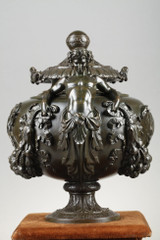
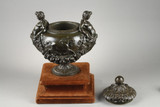
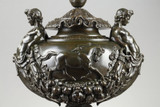

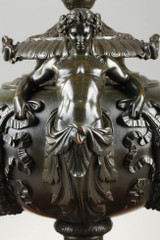
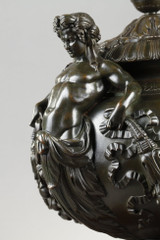


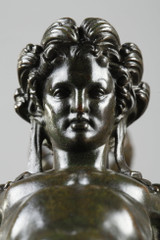

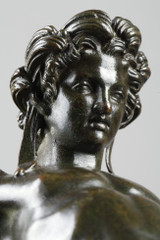

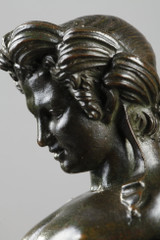
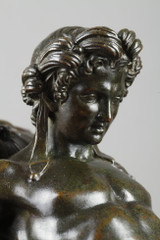


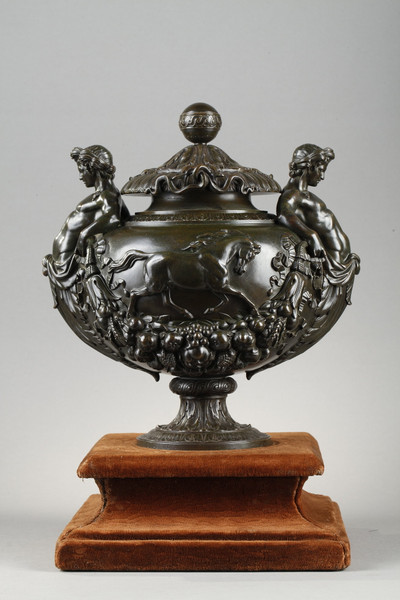
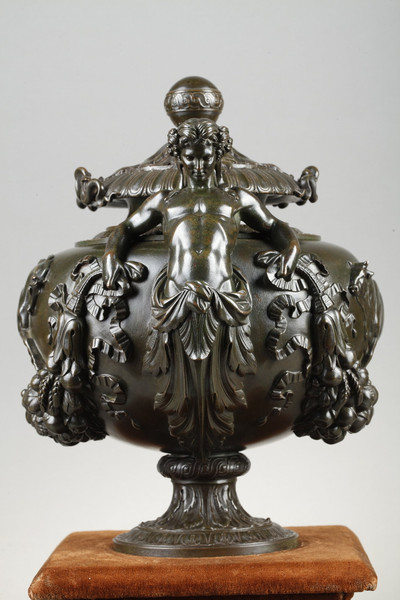

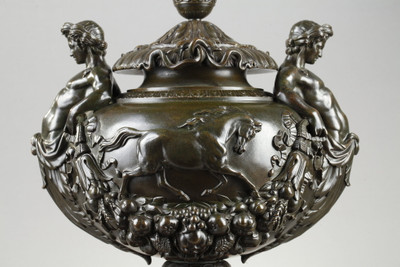


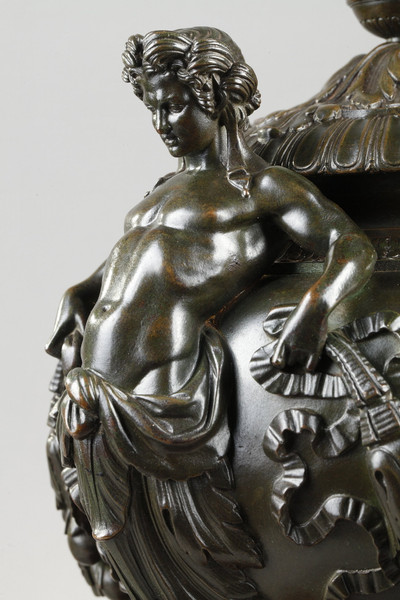


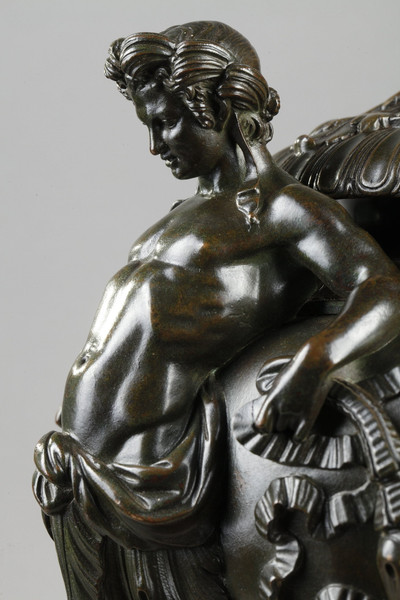

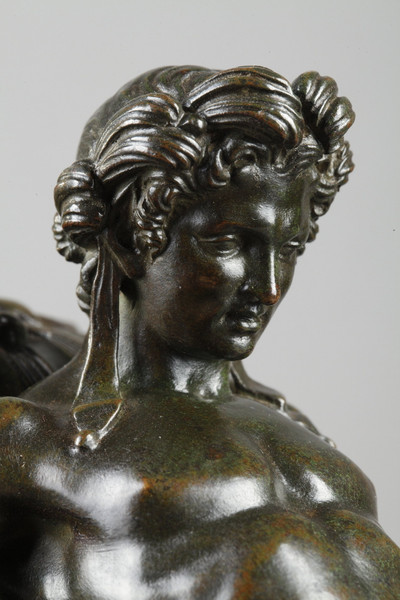


A patinated bronze urn on a pedestal, with a lid featuring a ball-shaped finial and decorated with acanthus leaves, egg-and-dart motifs, and entwined serpents. On the body of the urn, a galloping horse and a bull are depicted, both walking on a rich garland of fruit and wheat held at the sides by youthful male figures forming the handles. This urn rests on a stepped wooden base covered in velvet fabric, in its original condition. The bronze is signed Ferdinand Barbedienne.
Ferdinand Barbedienne (1810-1892) founded and managed one of the most important art foundries during the second half of the 19th century. He owes his renown both to his castings of ancient and modern sculptures, whose subjects were drawn from the greatest museums in Europe, and to his original bronzes, designed in his workshops. In addition to his own production, Barbedienne worked for renowned sculptors such as Barrias, Clésinger, and Carrier-Belleuse. Already recognized with two Grand Council Medals at the London Exhibition of 1851, the Barbedienne firm won a Grand Medal of Honor at the 1855 Universal Exhibition in Paris. The successes achieved by the Barbedienne firm at International Exhibitions consequently led to numerous official commissions. At the Great Exhibition in London in 1862, Barbedienne won medals in three different categories: furniture, silverware, and bronze art. Appointed an Officer of the Legion of Honour in 1867, he was made a Commander in 1878, following the Universal Exhibition where the jury compared him to "a prince of industry and the king of bronze." His fame did not wane over the years, as at the Universal Exhibition of 1889, critics praised Barbedienne for serving as a master to other bronze casters, thanks to the consistently exemplary quality of his bronzes.
Height without the base: 25 cm
Delivery
Europe: 100 EUR
US/Canada/HK: 200 EUR
Rest of the world: 300 EUR
- Reference :
- 8341
- Width :
- 26 (cm)
- Height :
- 34 (cm)
- Depth :
- 21 (cm)
- Era:
- 19th century
- Materials:
- patinated bronze