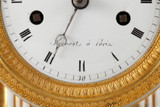


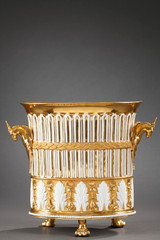


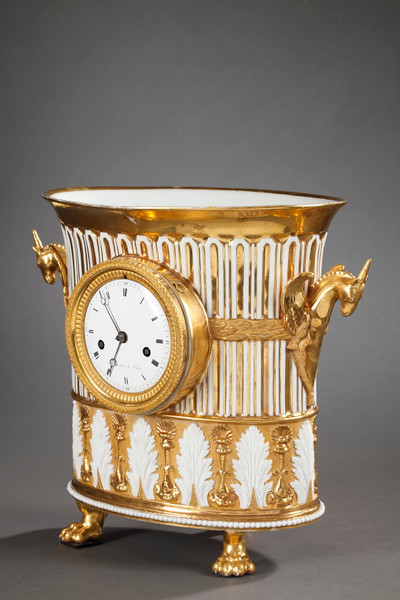

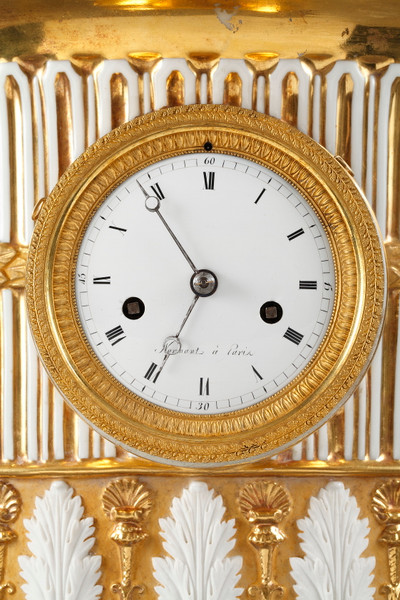
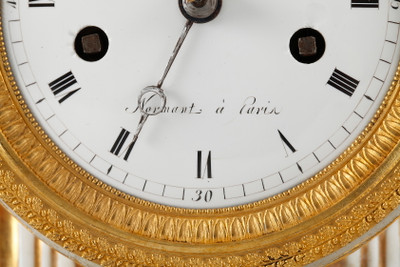


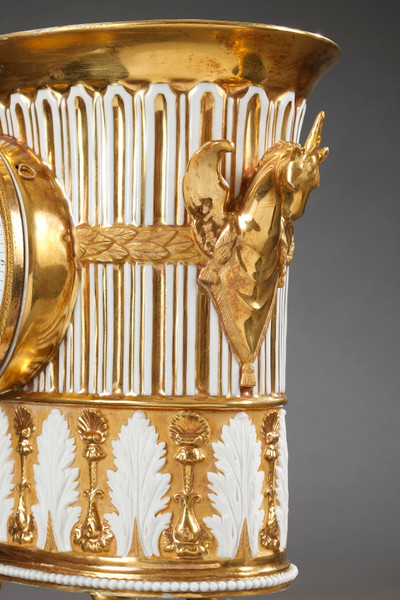
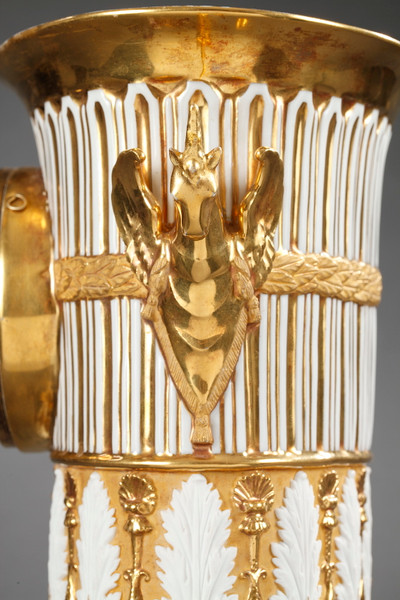
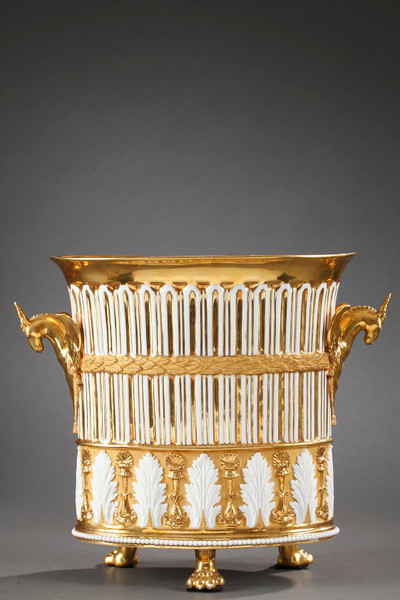
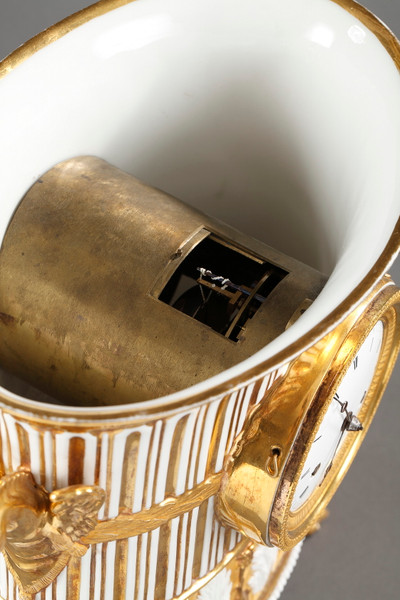

An interesting vase-shaped clock in gilt porcelain, signed "Normant à Paris," decorated around the rim with fluting embellished with foliage and small pearls, and at the bottom with a band adorned with alternating acanthus leaves and florets surmounted by shells. It has two small unicorn-shaped handles. The enamel dial features Roman numerals, and the Breguet hands in steel indicate the hours, quarter-hours, and minutes. It rests on a three-legged claw base. One horn has been reattached.
Movement serviced and in working order.
During the Empire and Restoration periods, the mantel clock, straight or rounded at the top, in bronze, marble, porphyry, or adorned with porcelain plaques, appeared in all its simplicity, without the scrolled consoles of its Louis XVI predecessors. Its ornamentation was also much more restrained and austere. Portico clocks displayed the same architectural and decorative rigor as the mantel clocks, with columns or pilasters supporting a horizontal entablature, and more rarely, a pediment. Finally, vase-shaped clocks ingeniously played with contrasts of materials and colors, often combining gilt and patinated bronze or white and gilt porcelain. The dial was set within the vase, and the handles could take various forms: winged figures, swan necks, ram's heads, chimeras, or unicorns, as in the case of our clock. Many clocks of this type were made of porcelain, mostly from Sèvres or Paris.
Bibliography: Pierre Kjellberg, Encyclopedia of the French clock from the Middle Ages to the 20th century, Paris, Les Éditions de l'Amateur, 1997, pp. 368-372.
Delivery
Europe: 100 EUR
US/Canada/HK: 200 EUR
Rest of the world: 300 EUR
- Reference :
- 4461
- Width :
- 30 (cm)
- Height :
- 26 (cm)
- Depth :
- 17 (cm)
- Era:
- 19th century
- Style:
- Empire
- Materials:
- Porcelain