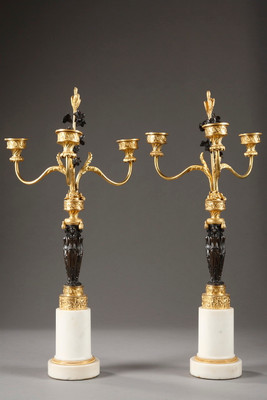
The Transition style (1765-1775)
The term Transition refers to the stylistic evolution which, in the second half of Louis XV's reign and at the very beginning of Louis XVI's reign, is characterized by...
Gold leaf restoration
Gold, a trendy color in decoration. Among the decorating trends of recent years: gold. In brass, metal, or gilded wood...
Tips for furnishing an Empire-style living room in a castle, mansion, or luxury apartment
For over 25 years, Galerie Atena has been helping its clients decorate their interiors: castles, manor houses, beautiful homes, luxury apartments… with…
Mythology in 19th Century Decorative Arts
Against the white-painted wainscoting stood eight mahogany chairs. An old piano supported, beneath a barometer, a pyramidal pile of boxes and cartons. Two...
How are porcelain biscuits made?
In our previous article, we explored the rich history of porcelain biscuit. This time, let's turn our attention to the techniques used to create these objects...
The Louis-Philippe style (1830-1848)
Beginning at the end of the Restoration (1830), the reign of Louis-Philippe continued until the Revolution of 1848 when the Parisian revolts...
The Directoire style (1789-1804)
The term "Directory" refers to a historical period following the French Revolution (1789) and the National Convention (1792-1795), but also to...
The Restoration style (1815-1830)
After Napoleon's defeat at Waterloo on June 18, 1815, power in France was taken over by Louis XVI's two brothers: the Count of Provence, who ruled...
Jacob Petit and Paris porcelain
In the 1830s, while Parisian decorators and porcelain manufacturers provided designs that perpetuated the neoclassical vocabulary, Jacob Petit (1796-1868 ...
The History of Porcelain Biscuit
Attention, sweet tooths! The biscuit we're about to talk about will make your teeth ache. Bust, peasant, prom queen, or centerpiece, they're immaculately white to...