Do you mean: small yellow?
Refine your search
Categories
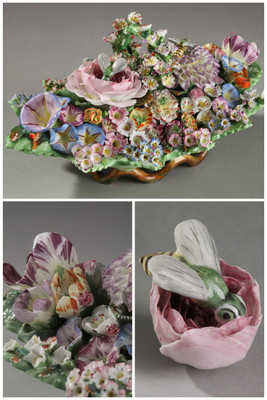
Jacob Petit and Paris porcelain
In the 1830s, while Parisian decorators and porcelain manufacturers provided designs that perpetuated the neoclassical vocabulary, Jacob Petit (1796-1868 ...
Travelogue about Japanese Arts and Crafts
We've just returned from a long trip to Japan, a country where we lived almost 30 years ago—an eternity! We had to go back to the place where we met. Where it all began, where our...
The folding screen, from its origins in Asia to 19th-century salons
The folding screen, this versatile decorative element, has endured through the centuries, bringing a touch of elegance and functionality to interiors...
The Louis XVI style (1774-1790)
After the period of experimentation with the Transition style (1765-1775), the Louis XVI style emerged in the early 1770s as the elegant expression...
Art Deco, the modernity of the Roaring Twenties
Who hasn't dreamed of having a drink in a sublime Art Deco setting, as if they were living in The Great Gatsby? Often considered the epitome of aesthetics...
Atena and her collection of Romantic-era art
"Romantic Paris, 1815-1848": The Petit Palais's landmark exhibition. From May 22 to September 15, 2019, the Petit Palais presents "Romantic Paris," an exhibition...
Napoleon III tables and pedestal tables
The Napoleon III style, which spans from approximately 1852 to 1870, is distinguished by a broad blend of styles from the 16th to the 18th centuries. A large number of pieces of furniture...
Edition Bronzes in 19th Century France
Edition bronzes: a social phenomenon. Small sculptures or edition bronzes are a surprising phenomenon...
The different engraving and printing techniques
Engraving and printing techniques are artistic methods that allow an image to be reproduced on various media. Engraving involves incising a surface to...
The Transition style (1765-1775)
The term Transition refers to the stylistic evolution which, in the second half of Louis XV's reign and at the very beginning of Louis XVI's reign, is characterized by...
The French clock
From the late 18th century onwards, artists rose up against classical rigidity and the cult of ideal beauty, expressing their preference...
Libraries and display cases, or the art of presenting collections
The bookcase as a storage unit. The bookcase is a piece of furniture designed for storing books, which appeared in England at the end of the 16th century, a little over...
Silverware in the 19th century
The housewife, an 18th-century invention. The practice of placing cutlery on the table, around each plate, became widespread from the 16th century onwards...
Rocaille, the story of an ornament
The rocaille style, often mentioned in contrast to classical ornamentation, appeared in Baroque Europe and developed until...
How are porcelain biscuits made?
In our previous article, we explored the rich history of porcelain biscuit. This time, let's turn our attention to the techniques used to create these objects...
Large format paintings in our collections
Large Format and History Painting: In the 19th century, painters interpreted everything related to their own time and earlier periods on large canvases...
Lighting fixtures in 19th-century France
19TH-CENTURY CHANDELIERS A chandelier is a piece of furniture designed to capture light and enhance the brightness of an interior. It is...
The Restoration style (1815-1830)
After Napoleon's defeat at Waterloo on June 18, 1815, power in France was taken over by Louis XVI's two brothers: the Count of Provence, who ruled...
How to decorate your restaurant with works of art?
Creating an inspiring space: Bars that display works of art, brasseries transformed by famous decorators, restaurants decorated by...
The mirror, an iconic decorative object
The history of the first mirrors dates back to around 6000 BC. The oldest examples are made of polished stone, then polished metal, copper...
Cylinder secretary after Riesener
The cylinder desk: an 18th-century invention. The cylinder desk is a piece of office furniture, created in the mid-18th century...
The Small Blue Lounge