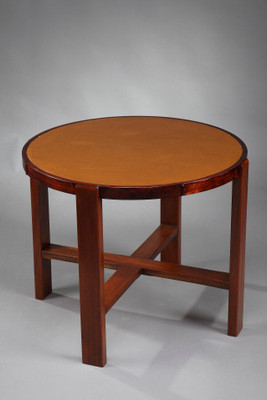

Do you mean: Art Deco?
Refine your search
Categories
- Catalogue > Design > Art
- Catalogue > Art Objects > Japanese Art
- Catalogue > Art Object
- Catalogue > Furniture > Furniture
- Catalogue > Furniture > Column
- Catalog > Lighting > Candlestick
- Catalog > Lighting > Chandeliers
- Catalog > Furniture > Painting
- Catalog > Design
- New products
- Catalogue > Sculpture
- Catalogue > Design > Furniture
- Catalog > Design > Lighting
- Catalog > Lighting > Wall Lights
- Catalogue > Art Object > Vase-Cutter
- Catalog > Sculpture > Bronze
- Catalogue > Sculpture > Marble
- Catalog > Lighting
- Catalogue > Art Object > Box
- Catalog > Lighting > Lamps
- Catalogue > Furniture
- Catalog > Furniture > Other
The Bargueño, a 17th-century Spanish cabinet
A Bargueño is a type of Spanish writing cabinet ("escritorio") that appeared at the beginning of the 15th century. However, the term was only coined in 1872 by Juan Facundo Riaño, a Spanish art historian
The folding screen, from its origins in Asia to 19th-century salons
The folding screen, this versatile decorative element, has spanned centuries, bringing a touch of elegance and functionality to interiors. From ancient China to 19th-century salons, the folding screen..
The French clock
From the late 18th century onwards, artists rebelled against classical rigidity and the cult of ideal beauty, expressing their preference for more realistic subjects, closer to their own time
The "boat" bed, a star of the Empire era
The "boat" bed, a French invention. In France, the "boat" bed was produced during the Directory (1795-1799) and was very fashionable during the Empire and the Restoration. Its name comes from its shape..
Mercier Frères Transition Style Commode
The Transition style: historical landmarks. The Transition style covers the period from 1750 to 1774 and refers to the stylistic evolution that, in the second half of the reign of Louis XV and at the very beginning of the 19th century..
1stdibs and Galerie Atena: a beautiful collaboration
Atena on online antique sales platforms: Galerie Atena benefits from a strong online presence, with virtual shops on Proantic, Selency, Vinterior, and 1stdibs. It is
The Louis XV style (1730-1760)
The peaceful and prosperous reign of Louis XV (1715-1774) allowed for a prodigious development of the arts, literature, and sciences. The construction of new palaces, the flourishing of painting, and the
The fêtes galantes in the era of Louis XV
You've surely seen them before, on porcelain, canvas, or even tapestry, these charming little couples courting each other in the countryside. But who are they? Why are they sitting right there?
Rocaille, the story of an ornament
The rocaille style, often discussed in contrast to classical antiquity, emerged in Baroque Europe and developed to the point of transforming the very structure of furniture and objects. The pieces of the
Large format paintings in our collections
Large Format and History Painting: In the 19th century, painters interpreted everything related to their own time and ancient times, allegorical and mythical scenes, on large canvases
The Empire style (1804-1815)
The Empire style developed under the impetus of Emperor Napoleon I (1769-1821), who reigned from 1804 to 1815. The first stirrings of the Empire style can be found as early as the Directory (1795-1799), but
Jacob Petit and Paris porcelain
In the 1830s, while Parisian decorators and porcelain manufacturers provided designs that perpetuated the neoclassical vocabulary, Jacob Petit (1796-1868) challenged tradition by proposing
The restoration workshop
Empire style ornamentation
The Empire style, a style of propaganda. At the end of the 18th century, Ancient Rome was celebrated both for its political grandeur and for what could be considered the pinnacle of its aesthetics
The Directoire style (1789-1804)
The term "Directoire" refers to a historical period following the French Revolution (1789) and the National Convention (1792-1795), but also to a style of furniture and decoration that covered
Medieval cuisine
Gold leaf restoration
Gold, a trendy color in decoration. Among the decorating trends of recent years: gold. In brass, metal, or gilded wood, gold furniture, lighting, and decorative objects..
The Napoleon III style (1852-1870)
A period of decadence, the Second Empire (1852-1870) sought to impose prestige through pomp, festivities, and luxury, in contrast to the bourgeois reign of the discreet Louis-Philippe. The Napoleon III style is the
Cylinder secretary after Riesener
The cylinder desk: an 18th-century invention. The cylinder desk is a piece of office furniture created in the mid-18th century, during the reign of Louis XV. It has drawers and compartments made of
The Louis XVI style (1774-1790)
After the period of experimentation with the Transition style (1765-1775), the Louis XVI style emerged in the early 1770s as the elegant expression of a return to classicism, free from the rigidity of taste
An incredible acquisition: "Voyage de la Sainte Famille en Egypte" by Georges Och
Georges Och, a largely unknown figure. Georges Och was a French landscape painter, born in 1798. To this day, little is known about the life and work of this artist who moved in the circles of..
The Restoration style (1815-1830)
After Napoleon's defeat at Waterloo on June 18, 1815, power in France was taken over by the two brothers of Louis XVI: the Count of Provence, who would reign as Louis XVIII (1815-1823),