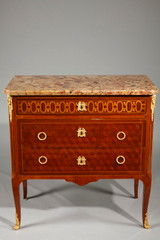
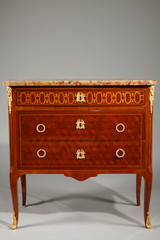
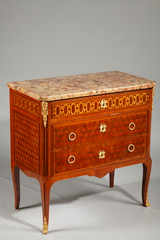

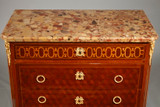
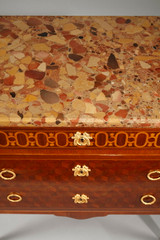
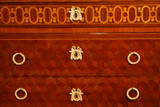
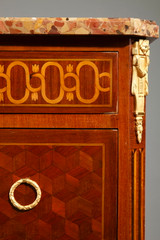

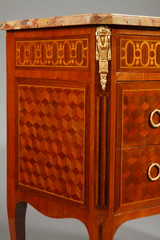
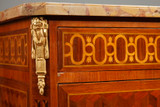
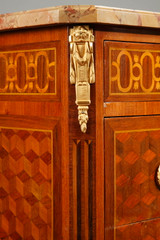

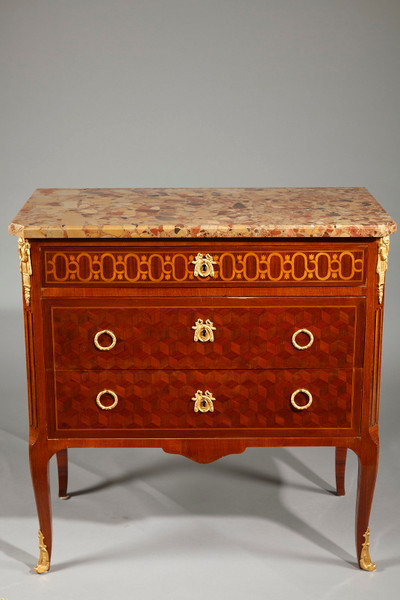
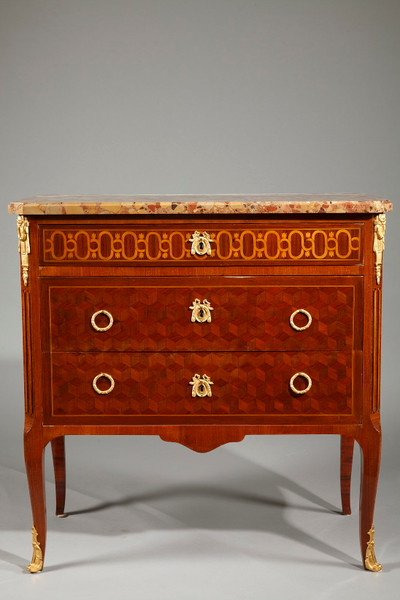
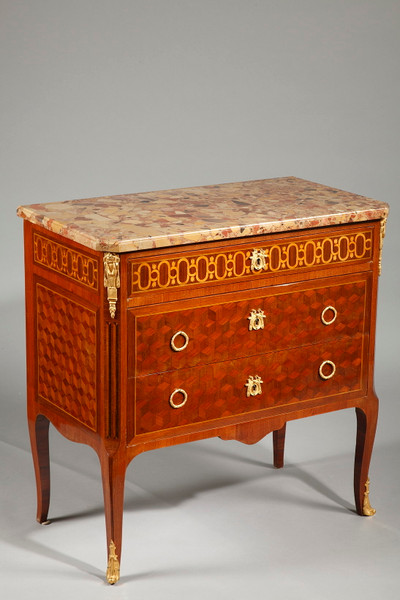
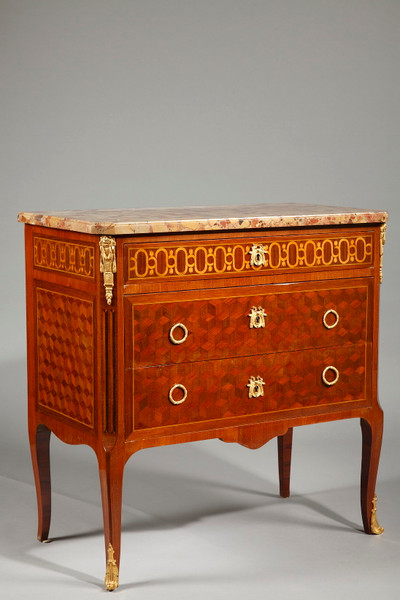

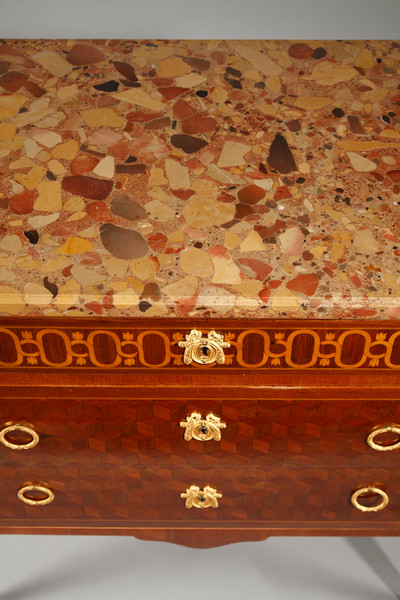
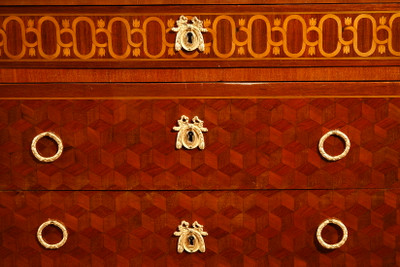

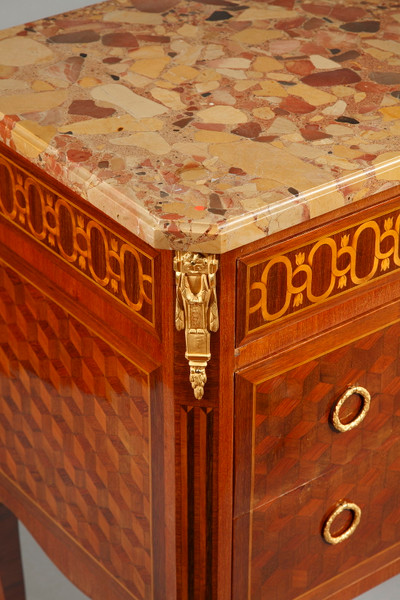

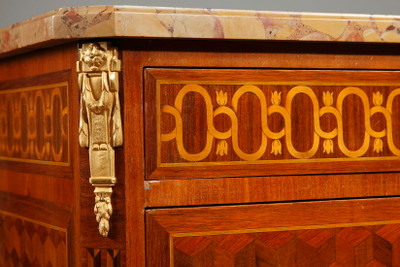
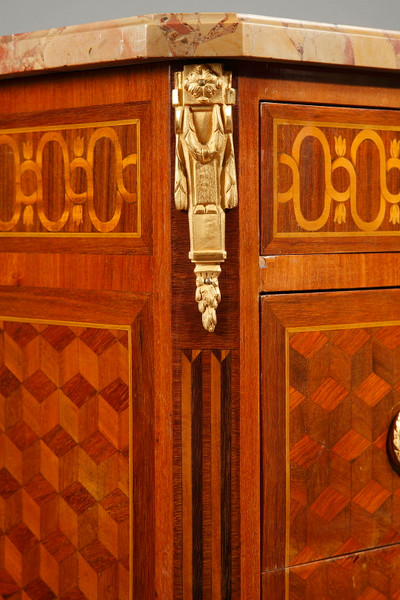
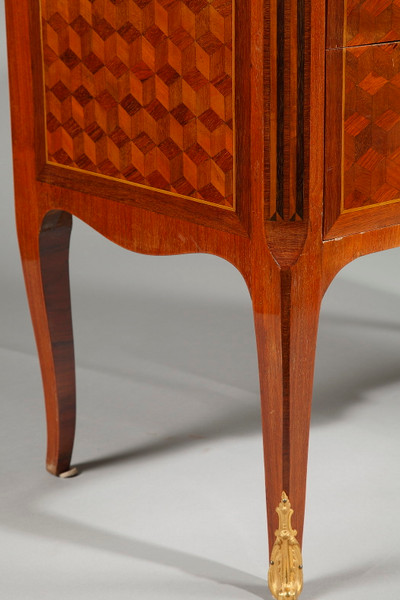
A Transition-style commode in rosewood and palisander marquetry, decorated with interlacing floral motifs, cubes, and trompe-l'oeil pilasters, opening to reveal three drawers without a central divider, with gilt-bronze and chased pulls in the form of laurel wreaths, and keyhole escutcheons surmounted by ribbons. Two gilt-bronze mounts depicting pilasters supporting garlands adorn the canted corners. It rests on four foliate sabot feet. The top is of Aleppo breccia marble with a double molding.
In the 18th century, the taste for Antiquity was widely disseminated through a continuous stream of publications, entire series devoted to ancient Greece and Italy, and archaeological studies. Faced with this popularity, it was inevitable that the Rococo style would eventually succumb. But the change in style occurred only gradually, both morphologically and decoratively. A transitional period of about a decade was indeed necessary for the assimilation and refinement of the new principles. As always, ornamentation came first, while lines and structure remained indebted to the old style. When the transition from Louis XV to Louis XVI was complete, however, furniture had entered the era of orthogonality and circular or elliptical curves, the latter supplanting the sinuous curves of Rococo. Legs composed of tapered, straight elements replaced the cabriole legs of Louis XV. Furthermore, the transition from the Louis XV to the Louis XVI style is marked by the enduring quality of the extraordinary technical skills developed by Parisian cabinetmakers during the reign of Louis XV. Indeed, the same woods were used, both native and exotic; mahogany, in particular, was highly prized. Marble tops retained their prestige and were carefully selected for their color.
Although First Empire furniture differs from that characteristic of Louis XVI, both styles are based on the same principle: the imitation of Antiquity. Thus, pilasters, consoles, and balusters, borrowed from classical design, are incorporated into the furniture. By far the most important element is the column, either freestanding or, more frequently, engaged, with a capital, turned and fluted shaft, located at the corners of commodes and other pieces of furniture.
The elegant secretaries and desks already popular during the reign of Louis XV were in vogue. Since furniture designed to blend harmoniously into a specific decorative setting remained a dominant concept during the reign of Louis XVI, pieces such as commodes, cabinet bases, and corner cabinets were produced in large quantities. In terms of decoration, the front of Louis XVI commodes was often still conceived as a single unit; the division between the drawers, far from being clearly defined, was usually concealed. As for the drawer pulls, these very frequently consisted of a ring with a crown motif set on a circular plate, sometimes adorned with a rosette.
Delivery
Europe: €500
US/Canada/HK: €600
Rest of the world: Price upon request
- Reference :
- 4511
- Width :
- 84 (cm)
- Height :
- 85 (cm)
- Depth :
- 47 (cm)
- Era:
- 19th century
- Style:
- Transition
- Materials:
- Rosewood, palisander, gilded bronze