
Empire style ornamentation
14.11.22
The Empire style, a style of propaganda
At the end of the 18th century, Ancient Rome was celebrated both for its political grandeur and for what could be considered the pinnacle of its aesthetics and canons of ideal beauty. It was Napoleon I (1804-1815) who, in his need to consolidate the newly established monarchy, gave rise to this austere and imposing style, in which furniture was enhanced with antique symbols applied in gilded bronze. The Empire style , by blending noble materials and antique emblems, simply placed art at the service of power.
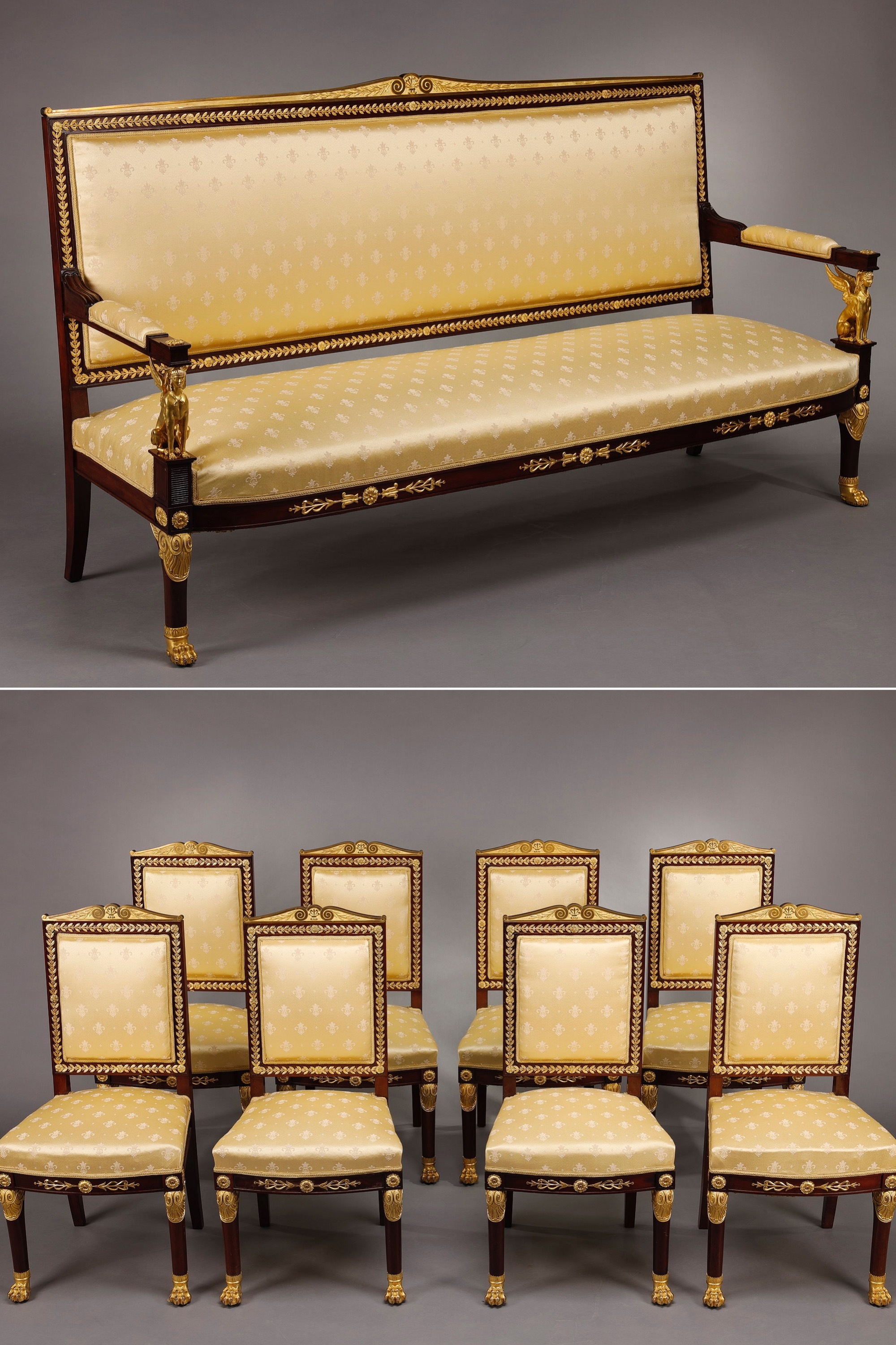
Empire style living room in mahogany and gilt bronze
Interior furnishings
To define the contours of this new " Empire style "Napoleon appointed Charles Percier (1764-1838) and Pierre-François-Léonard Fontaine (1762-1853) as government architects. They organized all the arts of the Empire and redecorated official residences. Furniture was then veneered in mahogany for the grandest homes, or more modestly crafted from native woods such as walnut, elm, ash, and golden beech, sometimes stained "mahogany-style" for bourgeois residences.
How to recognize the Empire style?
A collection of interior decorations published in 1801 and 1812. Napoleon's architects also enriched a vision of antiquity, discovered following their various trips to Rome. Other influential ornamentalists and designers, such as Jean-Démosthène Dugourc (1749-1825) with his marked taste for antiquity, or La Mésangère with his "Collection of Furniture and Objects of Taste," are also known to us. Among these decorative elements, most are drawn from the Greco-Roman ornamental vocabulary, but many also incorporate Egyptian, plant, geometric, and animal motifs.
The ornamental motifs
Greco-Roman motifs
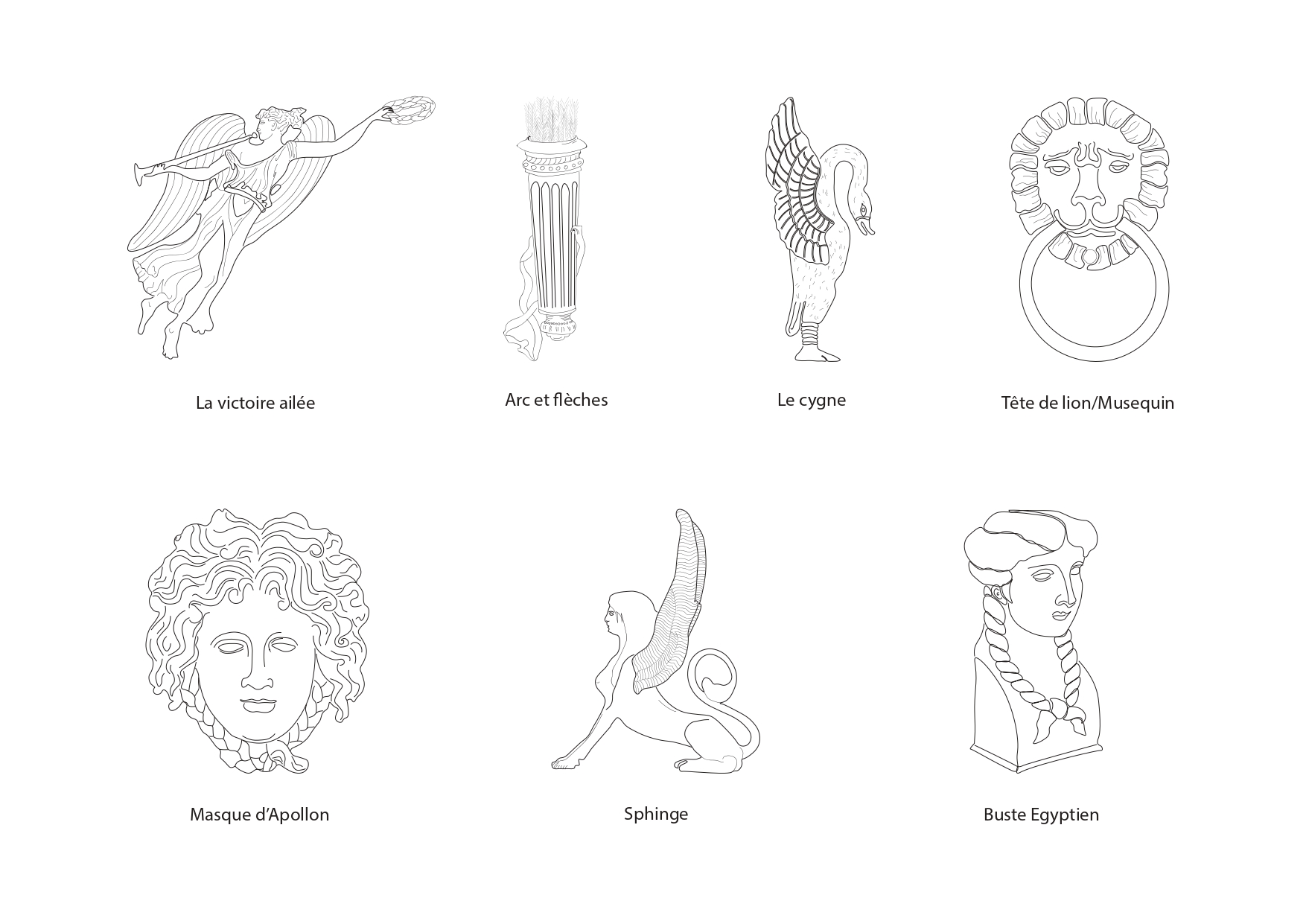
- Winged Victory
Victory was considered the personal goddess of the Emperor during the Roman Empire. In ornamentation, she is often depicted with wings, holding a laurel wreath and blowing a trumpet.
- The trophy (Greco-Roman motif)
An ornamental motif composed of a cluster of weapons and armor such as quivers, swords, helmets, spears, breastplates, etc. The motif most often depicts objects in mid-fall. The term "trophy" is, by analogy, given to an ornamental group of diverse attributes such as musical instruments or any other object representing a particular art or field. The trophy, a symbol of power, can be found on consoles, wall sconces, and even collectibles such as inlaid wooden boxes.
- The bow and arrows (Greco-Roman motif)
This decorative element originated in the Roman Empire. Indeed, in ancient Rome, the bow and arrows were considered powerful weapons from the very beginning of the Empire, depicted in the hands of emperors and gods. They thus became the symbol of Roman imperial power. It was with this same intention of emulating the grandeur of ancient Rome that Napoleon's "Empire style" adopted this ornamental motif.
- The swan
This was Empress Josephine's favorite motif. We know that she brought two black swans from Australia as part of the "Voyage to the Southern Lands" expedition and that she successfully bred them in captivity. Deeply attached to this delicate animal, it was only natural that she would feature it on her coat of arms.
- The lion's head (called Musequin)
A lion's head holding a ring in its mouth, commonly used as a drawer pull, etc. The lion is a symbol of strength, power, and sovereignty. It is very often depicted as the guardian of palace and temple gates, so featuring it on closed furniture makes perfect sense.
- Bust of an Egyptian woman
This depiction of an Egyptian woman's bust in a sheath appeared well before Napoleon's Egyptian campaign (1788-1790), that is, towards the end of Louis XVI's reign (1754-1793). This ornament was used extensively during the Directoire and Empire styles and became characteristic of them.
- The Sphinx
In ancient Greece, the sphinx, a woman with the body of a lion, was considered a source of enigmatic wisdom. She is depicted with the head and breasts of a woman, the body of a lion, and sometimes wings. In Empire furniture, she is often placed in corners.
Plant-based motifs
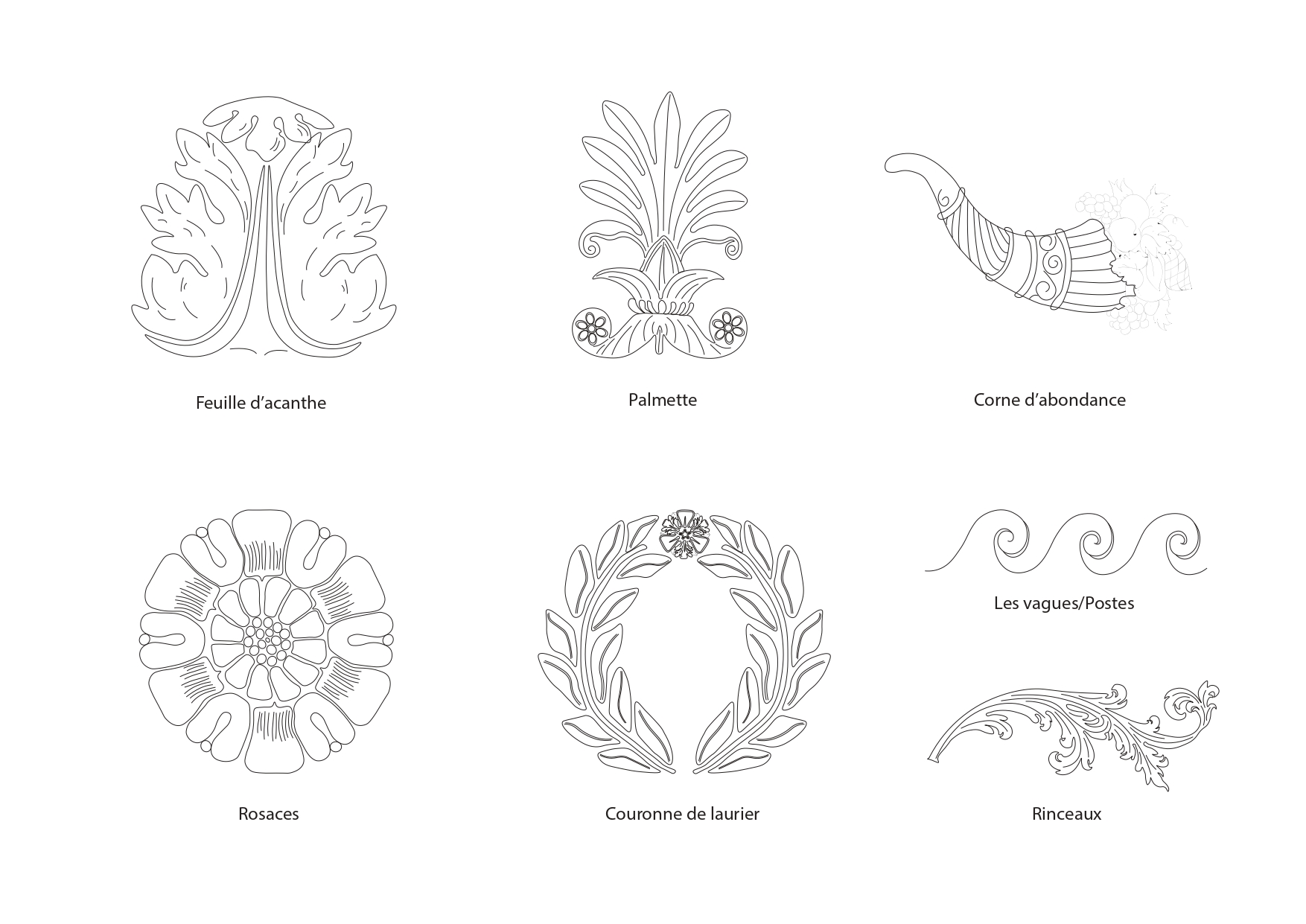
- The acanthus leaf and acanthus leaf scrolls (Greco-Roman motif)
A flower native to the Mediterranean coast, with veined and lobed leaves, acanthus has inspired countless ornaments since antiquity and remains an essential element of decoration. We can distinguish between the soft or cultivated acanthus, which, from the mid-5th century onward, was the principal motif of Corinthian capitals. It is represented in its wild, stylized, or realistic form. Enlarged and notched under Louis XV, it was simplified from the reign of Louis XVI onward, becoming more akin to wild celery, thistle, or parsley. In its "scroll" form, it is sculpted as an undulating branch into the hollows of which secondary, volute-shaped branches are grafted alternately. This ornamentation originated in Greece but has since been used in all periods.
- The palmette (Greco-Roman motif)
This Egyptian floral motif is formed of elongated lobes arranged in a fan shape. It is thought to be inspired by the palm leaf. The palmette is the quintessential ornament of Empire furniture and is incorporated into the composition of anthemions, repetitive motifs forming a frieze.
- The cornucopia (Greco-Roman motif)
It is a horn filled with flowers, fruit, and leaves. This motif originates from Greek mythology. Zeus, who was raised by a nymph at birth, was nursed by a goat named Amalthea. One day, while playing, Zeus broke off one of the goat's horns and gave it to his nurse, promising that it would always be filled with any fruit she desired. This symbol of abundance is highly prized in watchmaking and bronze work.
- The waves
A linear pattern formed of wavy ribbons representing flowing water, it is used on chiseled bronze objects as a belt ornament.
- The rosettes
This floral motif depicts a large flower with petals arranged in concentric circles. It is most often represented with six lobes in the Empire style.
- The laurel wreath
An attribute of Apollo, the laurel initially symbolized poetic glory and later became the Roman symbol of athletic success and military victory. The Empire style, like the Louis XVII style before it, made this motif one of its favorite decorative elements.
Geometric patterns
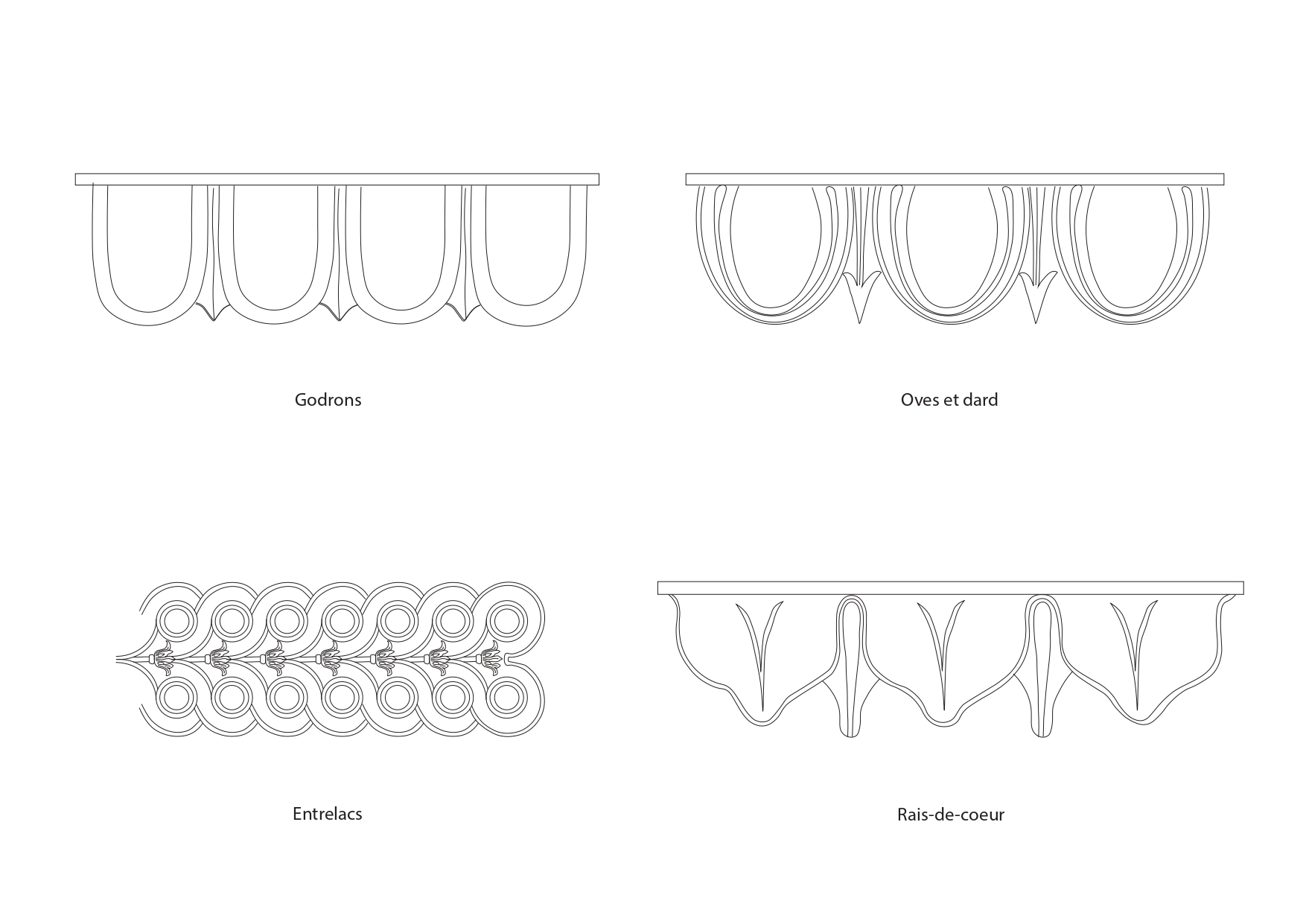
- Godrons, oves and dart
The gadroon is a swollen, elongated motif with a rounded end, which, like fluting, can be separated by leaves. Egg-and-dart moldings and darts are found alternately as architectural ornamentation. In Empire furniture, they are used as border motifs.
- Heart-shaped motif (Greco-Roman pattern)
This repeating motif features alternating overlapping leaves in which the central vein forms a heart shape. The heart shape may be accompanied by a secondary motif such as a palmette.
- Interlacing
Like heart-shaped motifs, gadroons, egg-and-dart motifs, this pattern of lines that intersect in curves and volutes is defined as a frieze motif, most often adorning the belts of Empire style furniture.
Columns and Orders
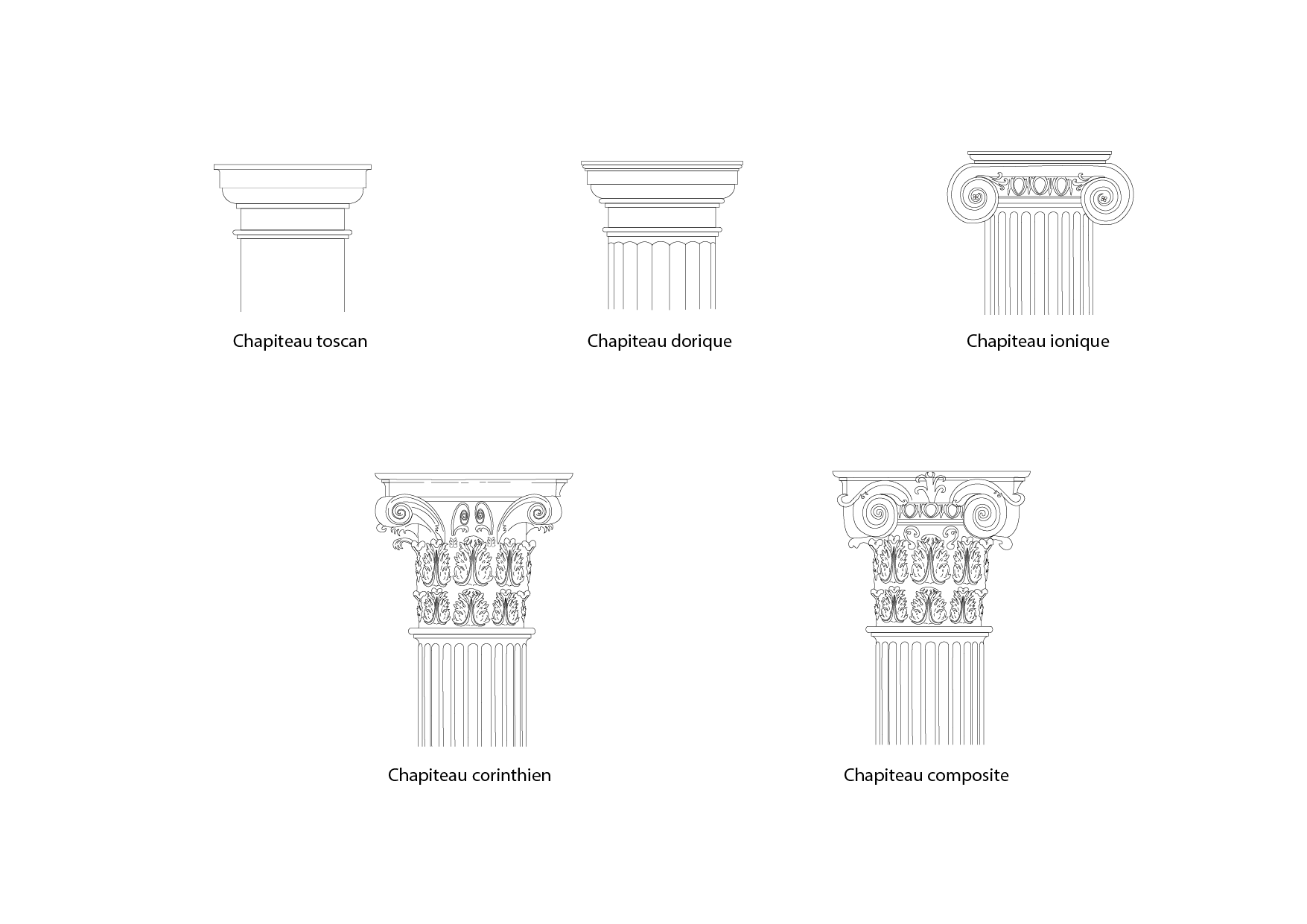
The Empire style also borrowed from Greco-Roman architecture, which is how columns with capitals appeared in furniture and furnishings: straight, with fluted shafts, adorned with gilt-bronze laurels or with capitals and bases of gilt metal, Empire columns also adopted Greek architectural orders. However, Napoleon's architects did not hesitate to experiment, mixing smooth shafts and molded capitals, sometimes disregarding classical conventions. This is probably one of the reasons why the reintroduction of classical columns into furniture was such a great success and why their production continued until the end of the 19th century.
- The Tuscan order
It is a sober Roman order, the shaft of its column is smooth and the echinus is borrowed from the contemporary Greek Doric order.
- The Doric order
This is the oldest order (existing in the Parthenon in Athens); it consists of a fluted column and a capital that is divided into sections from bottom to top. The word "Doric" comes from Doros, son of Hellen, who, according to Vitruvius, invented this order. We possess a pair of Doric pedestals that clearly illustrate this order.
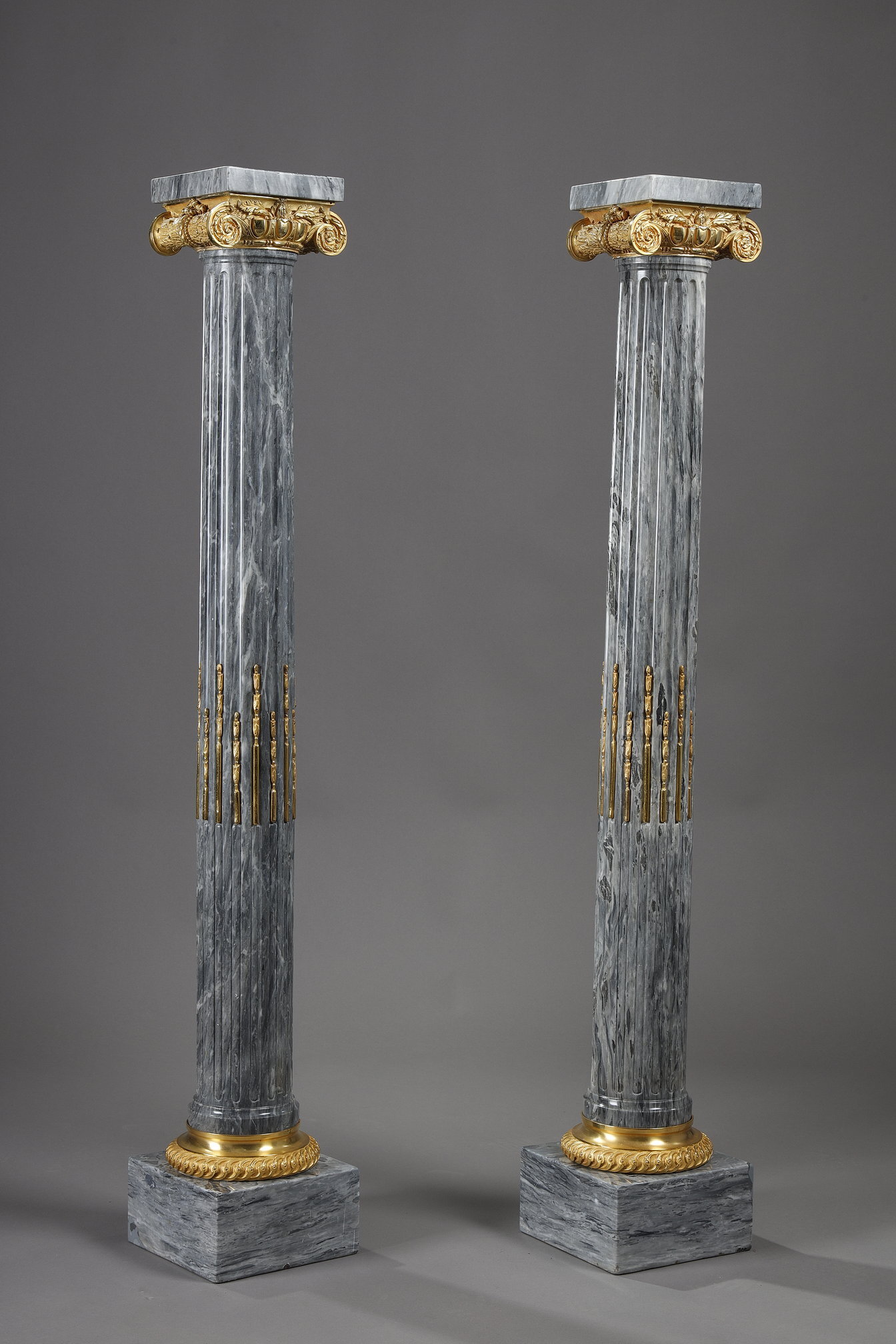
- The ionic order
This order originated in the Ionian region (Asia Minor), where we find numerous examples. Its column is slender, the shaft fluted, and the capital characterized by its volute cushion positioned between the base and the shaft (the echinus and abacus), as well as by its capital decorated with a beaded border and egg-and-dart motifs. Our pair of gray veined marble pedestals with Ionic capitals is a good example.
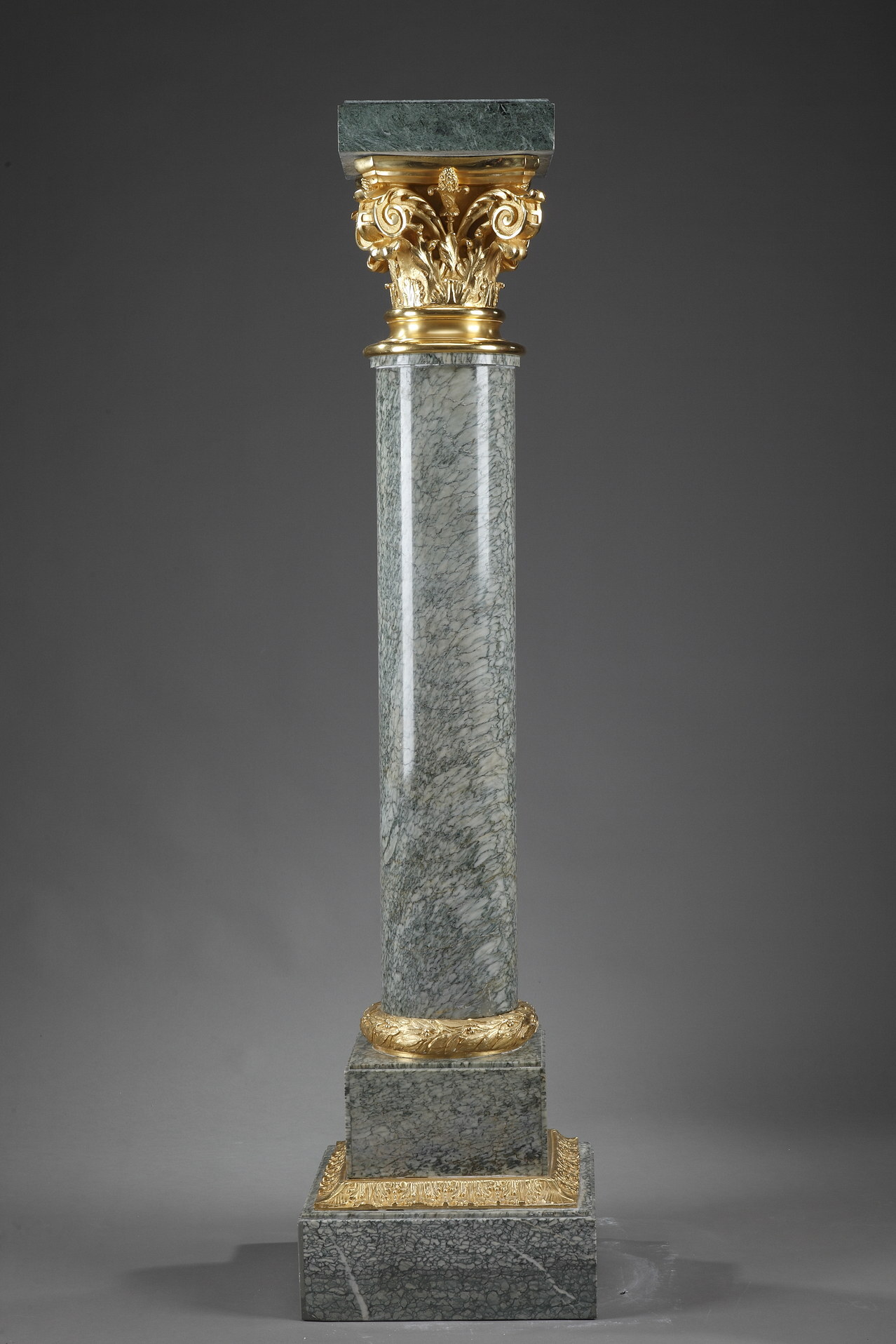
- The Corinthian order
This order, originating in Corinth, is characterized by a capital adorned with moldings of acanthus leaves blossoming into a double crown, along with fleurons and spiral motifs. The Corinthian capital, being the most richly decorated, was adopted as a model from the Renaissance onward, and naturally during the Empire. This important late 19th-century pedestal is a perfect example
- The composite order
This is an alteration of the Corinthian order, in which we find a superimposition of Doric, Ionic, and Corinthian orders. The base is Ionic, the shaft Doric, and the capital Ionic (by its volutes) and Corinthian (by its acanthus leaves). Our important pair of composite columns in pink marble clearly illustrates this order.
The Empire style established itself and dominated furniture design with its rigid appearance, straight lines, and especially its bronze decorations. Symmetrical, Empire furniture is straight and solid, composed of mahogany or mahogany veneer and adorned with gilt bronze ornaments, either matte or polished and finely chased. Desks ,wardrobes ,armchairs ,and clocks in the Empire style are always decorated with elements from the classical repertoire. The recent resurgence in popularity of this style has made it a must-have in the art and antiques market.
Bibliography:
THOMAS Évelyne, Illustrated Vocabulary of Ornament, through the Decoration of Architecture and Other Arts, Paris, Eyrolles Publishing, 2016.
DERROITTE Luc, Dictionary of Ornament, Paris, Jean-Paul Gisserot Publishing, 2012


