
 Daum Nancy service, 12 glasses, circa 1890
Art Nouveau and the Triumph of Glass
With the Universal Exhibition of 1900, glass became a preferred medium for the new aesthetic of the late 19th century. The new material appealed to those who favored curved lines and the effects of light, thanks to its flexibility and ductility. Indeed, glass can be worked on the surface and in depth, hot or cold; it can create transparent effects similar to those of crystal or can be opaque like pâte de verre.
Master glassmakers produce their creations in small series, which makes them rare and sought after today. Small Gallé vases, Gallé lamps, Daum vases or Lalique vases, these glass creations from the 1900s, witnesses to the revival of the art of glass, remain expensive on the market - whether they are unique pieces or mass-produced items.
The Gallé vase
Who is Émile Gallé?
An emblematic figure of Art Nouveau, founder of the École de Nancy, Émile Gallé (1846-1904) is known worldwide and recognized as the inventor of glass marquetry. This process, imitated from metal plating, aims to "insert, while hot, into the still-pasty glass mass, fragments, strips or small masses of varying thickness and shapes, either bare or under a covering of other glass" [Philippe Thiébaut, "Gallé and glass marquetry", La revue du musée d'Orsay, no. 18, 2004, p. 100].
The technique of glass marquetry allows for an infinite number of chromatic variations and highly detailed patterns. The price of a Gallé vase can be very high, especially for pieces produced during his lifetime, before 1904. Vases made using this technique are extremely valuable and can fetch several hundred thousand euros.
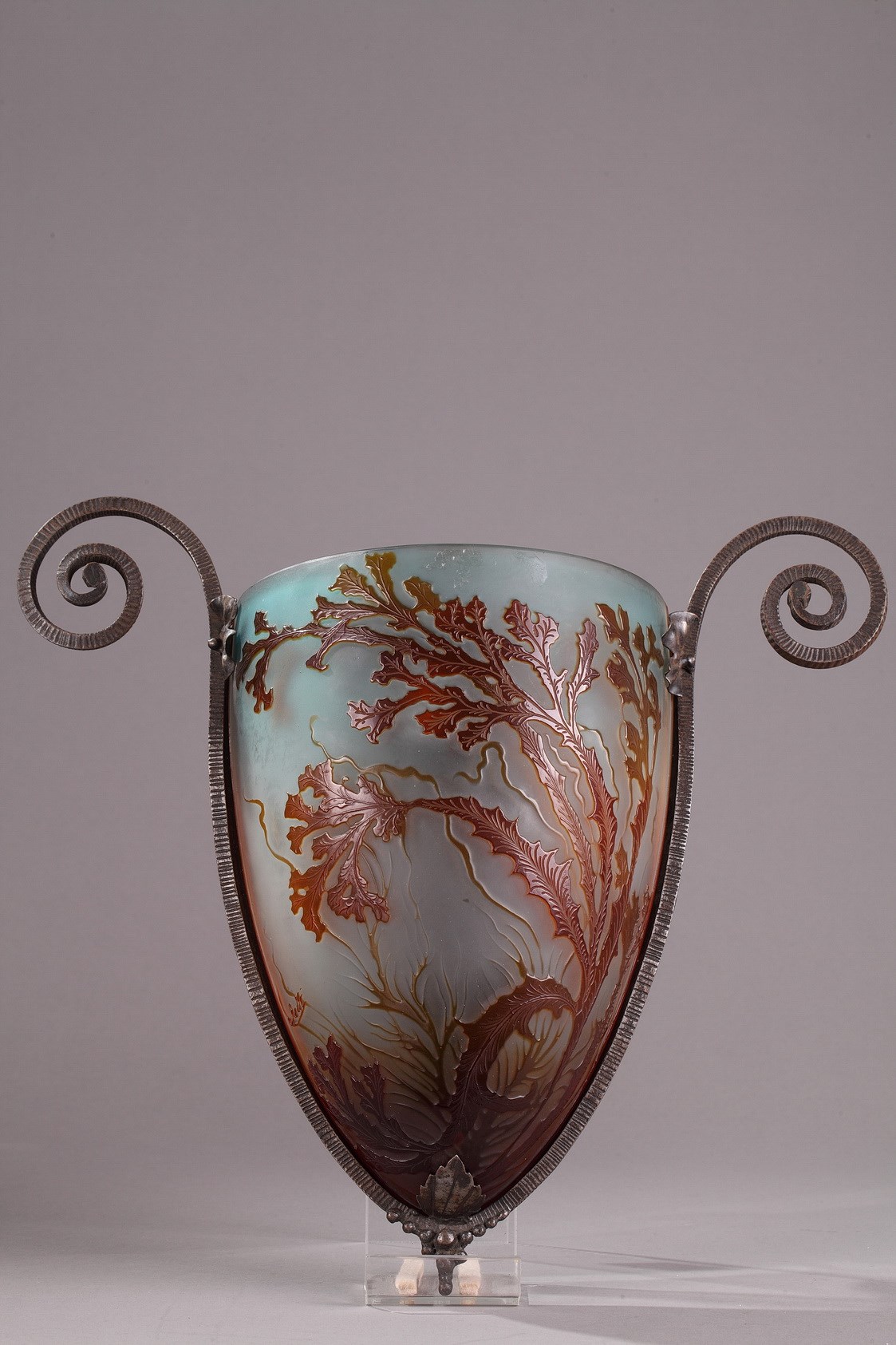 Gallé wall sconce in acid-etched glass with seaweed decoration, circa 1900
How to recognize a genuine Gallé vase?
Three elements must be taken into account to distinguish a genuine Gallé from a fake Gallé :
- The price
- The technique
- The signature
The price is very important for the master's unique pieces (vases, pots, lamps, suspensions and bottles), made before 1904, and less important for mass productions.
Regarding the technique, two production methods coexist:
- Unique pieces , recognizable by their reliefs and motifs, appearing in transparency, using highly complex techniques including marquetry on glass. These Gallé vases are rare and particularly sought after by discerning collectors;
- Mass-produced pieces , recognizable by their acid-etched decoration
Note that the glass must be thick and the relief engraving fine. The inside of a Gallé vase is smooth.
The signature of a Gallé vase is hand-engraved for unique pieces; an acid-etched monogram with the word "Cristallerie" is used for series productions made before 1904. A mark is used for posthumous production (after 1904 and until the liquidation of the company in 1931).
The Daum vase
Auguste and Antonin Daum: French glassmakers of the Nancy School
The brothers Auguste (1853-1909) and Antonin Daum (1864-1930) were very close to Émile Gallé, with whom they shared a passion for glass and botany. From 1891 onwards, the Daum brothers introduced artistic workshops into their glassworks, and achieved great mastery in the techniques of glass engraving and plating .
The Daum Frères crystalworks won numerous awards at international exhibitions, including a Grand Prix at the 1900 Universal Exhibition. Daum exhibited decorative and functional glassware (glass and crystal tableware), as well as lighting fixtures highly valued for their industrial and commercial worth: living room lamps, desk lamps, nightlights, and Art Nouveau lanterns adorned with engravings of birds and plants. Vases in multi-layered glass with wheel-engraved decoration were also presented, such as the "Tristan and Isolde Vase," now in the Musée des Beaux-Arts in Nancy. Vases with figures are relatively rare in Daum's production. The piece presented at the 1900 Exhibition depicts the two main characters from Wagner's opera.
In 1901, Gallé and the Daum and Gallé brothers founded theÉcole de Nancy, alongside the cabinetmakers Vallin and Majorelle.
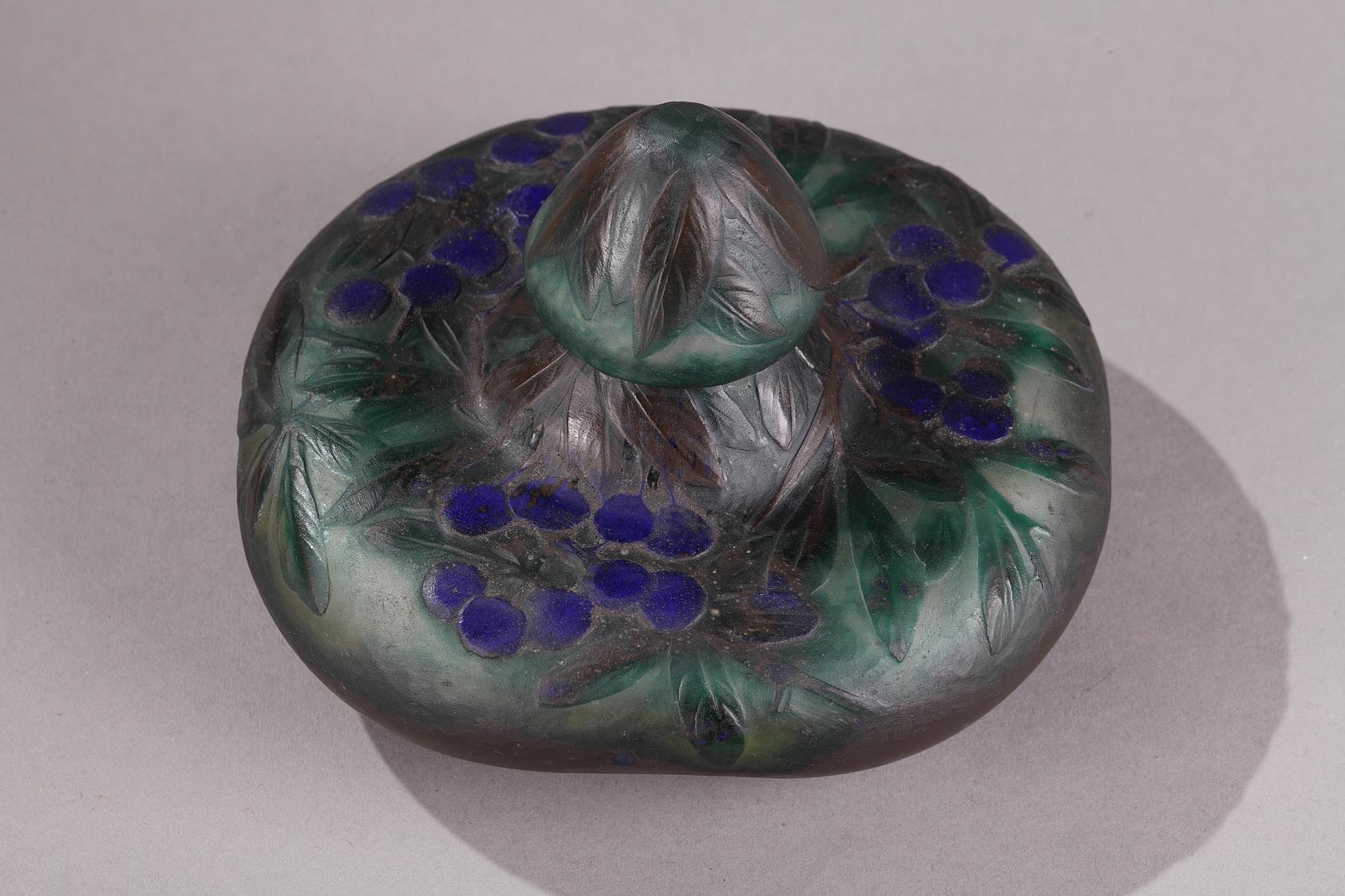 Daum inkwell in blue and green glass with engraved decoration, signed Daum Nancy
How to recognize a Daum vase from the Art Nouveau/Art Deco period?
Authentic Daum crystal pieces can be recognized by the following features:
- The signature : Daum objects and vases are signed Daum Nancy/Daum France, accompanied by the Cross of Lorraine. Older signatures were most often molded, meaning they appear in relief on the piece.
- The technique : a Daum is a work of art made of glass, pâte de verre , or pâte de cristal. The pâte de verre or pâte de cristal has a particular grain, similar to the skin of a peach, making each piece unique.
- The decoration : can give a clue as to the year the piece was made. A floral style is characteristic of Art Nouveau and the Nancy School, while a geometric style is typical of Art Deco. Naturalistic inspiration is widely reflected in vases from 1900.
The Lalique vase
After Lalique jewelry, now Lalique glass
Before becoming a master glassmaker, René Lalique (1860-1945) made a name for himself as a jeweler. The 1900 Universal Exhibition cemented his reputation with a wealthy international clientele. After a successful collaboration with François Coty in 1907, for whom Lalique created his perfume bottles, he abandoned jewelry making for glassmaking. Lalique was then 58 years old.
As a master glassmaker, Lalique employed modern industrial techniques while maintaining the exacting standards ofluxury craftsmanship. He developed the pressed glass technique ; pieces are formed by applying pressure to the glass paste using a metal counter-mold or core. However, Lalique retained the traditional methods of blown-molded glass and lost-wax casting, which allowed for the creation of highly precise molds. The industrial processes he implemented in his factories were complemented by meticulous attention to detail in the finishing (acid etching, felt wheel polishing) and patinas.
Lalique produced a vast array of glass objects: Lalique vases are among the most sought-after, but there are also bowls, dishes, inkwells, ashtrays, carafes, and drinking glasses. He also created numerous models of lamps, ceiling lights, wall sconces, and candelabras.
Some designs are typical of Art Nouveau, such as his nymphs with long hair. Others are characteristic of Art Deco and are adorned with geometric friezes of birds, figures, and garlands of flowers and foliage arranged in a rigorous manner. The 1925 International Exhibition of Modern Decorative and Industrial Arts marked Lalique's triumph.
How to recognize a Lalique vase
Antique Lalique vases and glass objects are recognizable in particular by the following elements:
- The signature
- The technique
The signature :
- With the exception of chandeliers and lanterns, all of the glassmaker's creations produced between 1919 and 1945 are signed "R. Lalique" (R for "René"). The presence of the simple letter "R" can drive up prices, sometimes by several thousand euros for these highly sought-after pieces, as they were made during his lifetime.
- The signature "Lalique France" is the current signature of the Lalique crystal factory.
- The VDA signature was used between 1921 and 1923 and stands for "Alsace glassworks". Founded in 1921 in Wingen-sur-Moder, it was in this factory that the new collections were manufactured.
- The numbered Lalique signature is affixed to limited edition pieces. These pieces are always more valuable than other Lalique glassware.
The technique :
- Before 1945, Lalique glass had a low lead oxide content, making it less brilliant and more opaque. Colorless Lalique glass made before René's death glows yellow under black light.
- Lalique sometimes used colored glass (brown, green, red, blue, grey, yellow or black) and opalescent glass whose tint varies from pale blue to deep blue depending on the intensity of the light.
- He rarely uses email applications.


