


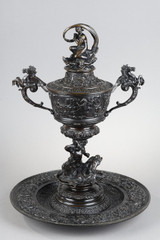


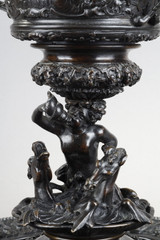


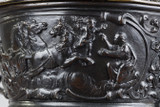


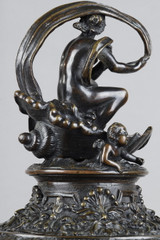
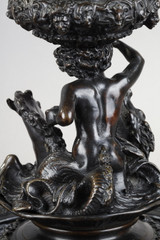
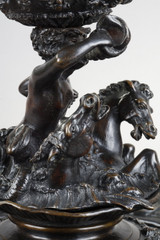
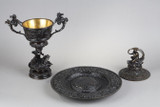

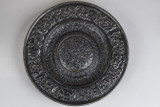
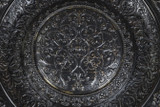


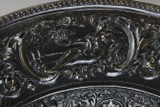


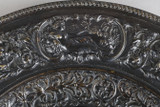
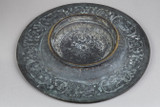
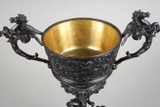


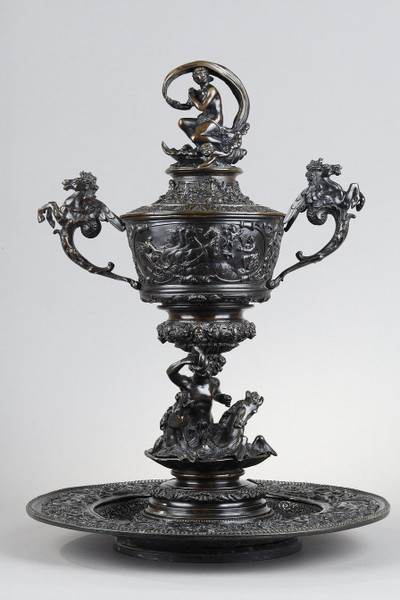


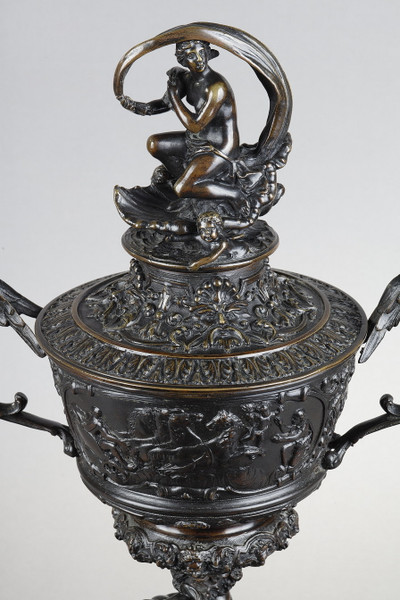
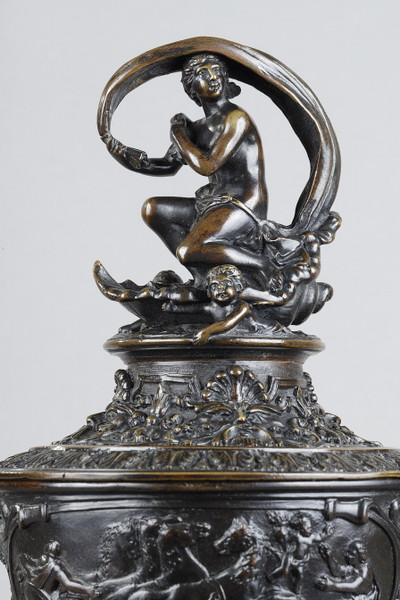


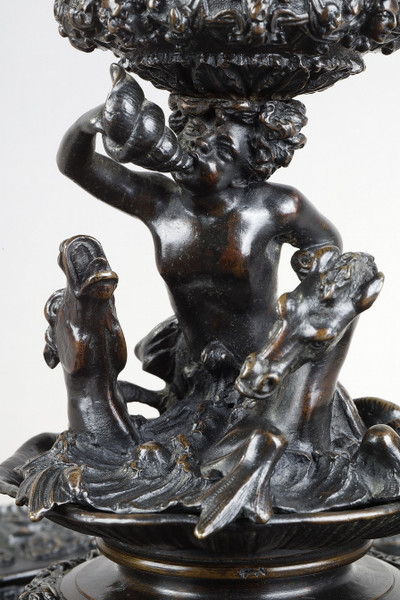
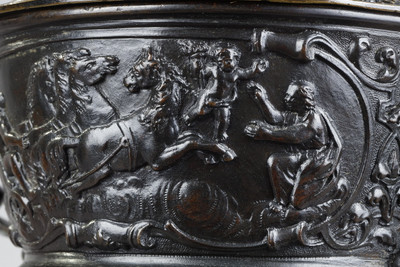


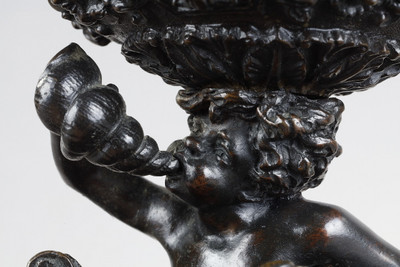
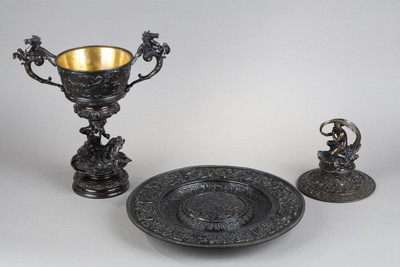
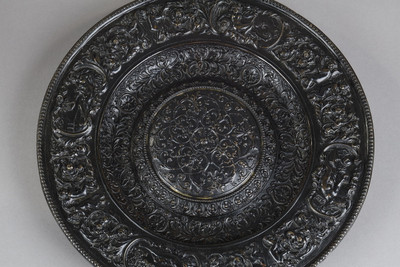
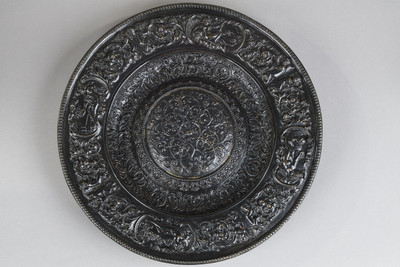

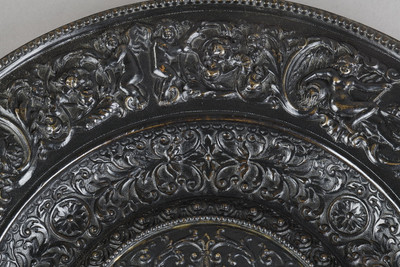
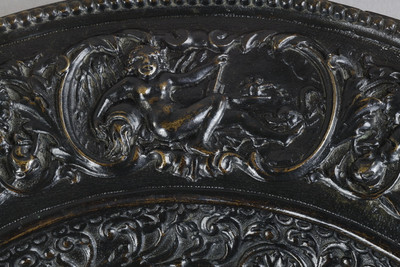


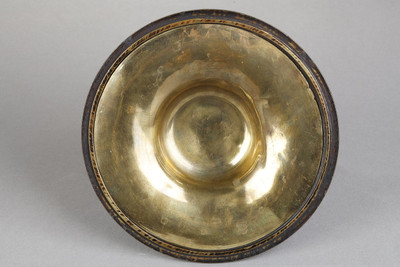
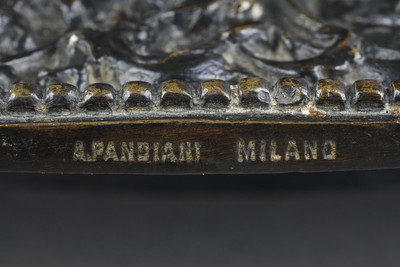
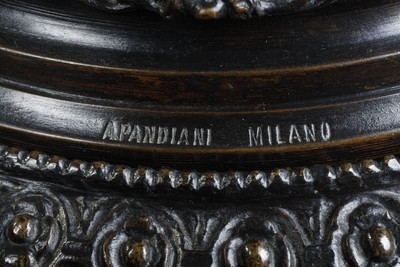
A pedestaled cup in the form of a triton emerging between two water horses and blowing into a conch shell. The lid is surmounted by a Nereid, probably Thetis, seated on a conch shell, a veil billowing in the wind. Two winged horses in a rearing posture form the handles. The body of the cup is decorated on one side with Cybele seated in her chariot drawn by two lions guided by a satyr holding a tyrsus (an attribute of Dionysus). The other side depicts a man looking back, seemingly fleeing, seated on a chariot drawn by four horses galloping across the waves. The whole rests on a multi-tiered plate decorated with grotesques in the style of Roman antiquity, rediscovered during the Renaissance. Signed A. Pandiani Milano (1838-1928).
This set refers to a legend recounted in the Iliad :
As an adult, Dionysus (son of Zeus and the mortal Semele) discovered the vine and its uses. Hera, jealous of this child born of her husband Zeus's infidelity, drove him mad. In this state, the god wandered through Egypt and Syria. Thus, traveling up the coasts of Asia, he reached Phrygia, where he was welcomed by the goddess Cybele, who purified him and initiated him into the rites of her cult. Once freed from his madness, he went to Thrace, where he was very poorly received by King Lycurgus, who reigned on the banks of the Strymon River. Lycurgus tried to capture the god, but he failed, for Dionysus fled to Thetis, the Nereid, who gave him refuge in the sea. Thus, in this vase, we find Cybele, his protector, the flight of Dionysus, and Thetis's marine world
Born into a family of artists, Antonio Pandiani was a renowned Milanese sculptor. Along with his brother Costantino (1837-1922), creator of the famous Pukki statue in the Helsinki Zoo, he championed the Lombard Neoclassical style, exhibiting frequently at shows organized by the Brera Academy. Soon after becoming a sculpture professor at the same school, Antonio took over the foundry in 1886. From then on, thanks to the high artistic output supported by the artist and his family, he continued to create innovative subjects.
A celebrated sculptor with a vibrant academic style, Pandiani was best known for his numerous portraits, such as the bronze bust of Alessandro Manzoni (now in the collections of the GAM in Milan, 1905) and that of Queen Victoria, signed and dated 1890 (Anglesey Abbey, The Fairhaven Collection, The National Trust). Often dedicated to reproducing historical monuments in miniature, such as the bronze copy of the Istrian stone wellhead in the Campo Santi Giovanni e Paolo in Venice, Pandiani executed the sculpture with Vittorio Emanuele II as the hunter.
Alongside this more historicist production, we must remember the artist's fine work in the form of finely decorated bronze cups and vases, such as the specimens now kept at the Museum of Toscanini's birthplace in Parma.
Delivery
Europe: 200 EUR
US/Canada/HK: 350 EUR
Rest of the world: 500 EUR
- Reference :
- 8179
- Width :
- 35 (cm)
- Height :
- 49 (cm)
- Depth :
- 35 (cm)
- Era:
- 19th century
- Style:
- Renaissance
- Materials:
- patinated bronze